Why We Stopped Using ERC20 USDT — Real Fee Data and Better Alternatives (2026)
99% of ERC20 articles online tell you "how to transfer." This one tells you "why we don't." A real account from an AI automated trading team that migrated from ERC20 to TRC20/BEP20, with the latest post-Pectra fee data.
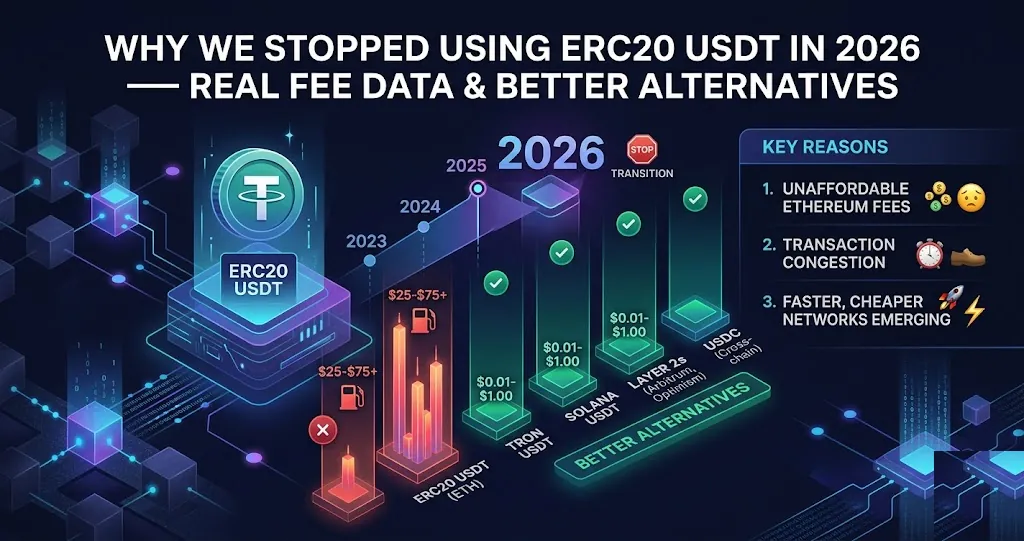
In 2022 we were still using ERC20 USDT to move client funds. $30 or $50 per transfer wasn't unusual. We gradually migrated to TRC20 and BEP20 — not because individual fees were too high, but because the cost was unpredictable. This article walks through that decision, and tells you when ERC20 still makes sense for your use case.
This is the third article in our USDT network series. The previous two covered TRC20 (most universal) and BEP20 (cheapest). This one takes a different angle: ERC20 on Ethereum mainnet — why CoinTech2u has largely stopped using it, and which scenarios still call for it.
1. What Is ERC20 USDT?
ERC20 is the token standard on Ethereum, proposed by Vitalik's team in 2015. It defines how tokens are issued, transferred, and queried on the Ethereum network. USDT-ERC20 is the version of USDT that Tether issued on Ethereum in 2017 — historically one of the first widely circulated stablecoins.
ERC20 occupies an "industry default" position in crypto:
- Native support across every major exchange, wallet, and DeFi protocol
- The first choice for institutional and compliance use (tax, audit, reporting)
- Highest decentralization of any major chain (Ethereum has 1M+ validators)
- ERC20 still holds ~40% of total USDT supply (second only to TRC20's ~50%)
2. ERC20 USDT Fees (Post-Pectra, 2026)
Let's start with what's true: ERC20 is no longer the $50-per-transfer monster of 2021–2022. The May 2025 Pectra upgrade (EIP-7702 and others) plus widespread Layer 2 adoption have lowered Ethereum mainnet load and gas prices significantly.
May 2026 Real Data
| Network State | Gas Price (Gwei) | USDT Transfer Cost | USD (ETH≈$3,000) |
|---|---|---|---|
| Very idle (late-night Asia hours) | 0.3–1 Gwei | ~0.00002 ETH | ~$0.05–$0.20 |
| Normal active hours | 3–10 Gwei | ~0.0002–0.0007 ETH | ~$0.50–$2 |
| Moderate congestion | 15–30 Gwei | ~0.001–0.002 ETH | ~$3–$6 |
| Peak (meme/NFT hype) | 50–100 Gwei | ~0.003–0.0065 ETH | ~$10–$20 |
| Extreme events (liquidation cascade, exploit) | 200+ Gwei | 0.013+ ETH | $40+ |
Takeaway 1: Saying "ERC20 USDT is always expensive" is no longer accurate. Late-night idle hours can genuinely cost just a few cents.
Takeaway 2: But within the same week, the cost can range from $0.10 to $20 — a 200× swing. That's the real problem.
3. The Real Problem with ERC20 — It's Not the Cost, It's the Unpredictability
As a team operating an AI automated trading system, what matters to us isn't "cheapest" — it's "predictable cost."
Three-Chain Cost Volatility (May 2026 sample)
| Chain | Lowest Cost | Highest Cost | Volatility |
|---|---|---|---|
| TRC20 | $1.44 | $3.90 | ~2.7× |
| BEP20 | $0.05 | $1.00 | ~20× |
| ERC20 | $0.05 | $40+ | ~800× |
An 800× swing means you can't reliably budget for ERC20 costs in financial forecasts, customer pricing, or automated fund routing.
The Real Pain Points We Hit
On the CoinTech2u platform, USDT transfers only happen in two scenarios: (1) users depositing to purchase point cards (user pays); (2) commission payouts (chain fees covered by CoinTech2u). Both are sensitive to ERC20's "expensive" and "volatile" nature — just affecting different parties:
- Users abandon deposits when gas spikes — A user lining up to pay $300 for a point card sees gas hit $15 and walks away. That's a 5% tax just to get in the door — a real, ongoing conversion-rate killer.
- Our batch commission payouts become unbudgetable — Sending USDT commissions to dozens of affiliates at once is predictable on TRC20, but on ERC20 each payout could be $5 or $50. Finance can't forecast monthly spend.
- Slow confirmations create support load — ERC20's 12–15 second on-chain confirmation plus exchange risk review means 5–10 minute end-to-end credit times (30+ minutes during congestion). BEP20/TRC20 land in 1–2 minutes — significantly fewer "where's my transfer?" support tickets.
So we moved deposit and withdrawal flows to TRC20 (for universal compatibility) and BEP20 (for lowest cost), keeping ERC20 only for specific edge cases.
4. ERC20 vs TRC20 vs BEP20 — Full Comparison
| Dimension | ERC20 (Ethereum) | TRC20 (TRON) | BEP20 (BNB Chain) |
|---|---|---|---|
| Per-transfer cost range | $0.05–$40+ | $2–4 | $0.05–$1 |
| Cost predictability | Poor (800× swing) | Excellent (2.7×) | Medium (20×) |
| Confirmation time | ~12–15 sec | ~3 sec | ~3 sec |
| Exchange support | All major | All major | Most |
| USDT supply share | ~40% | ~50% | ~5% |
| Decentralization | Highest (1M+ validators) | Lower (27 SRs) | Lower (21 validators) |
| Compliance acceptance | Industry default | Widely accepted | Widely accepted |
| DeFi ecosystem | Richest | Limited | Substantial |
5. When ERC20 Is Still the Right Choice
Scenario 1: Institutional cold storage ($1M+ long-term)
If funds aren't moving, paying $5–15 once for entry is fine. In return you get the security of 1M+ validators, zero centralized shutdown risk, and the highest compliance acceptance. For funds, corporate treasuries, or DAO treasuries, ERC20 is essentially the only option.
Scenario 2: Ethereum mainnet DeFi
Aave lending, Uniswap trading, Maker collateral, Lido staking — these protocols live on Ethereum mainnet. If your strategy involves DeFi arbitrage, liquidity provision, or collateral lending, ERC20 USDT is the native currency. In this context, gas is part of the strategy, not "unnecessary cost."
Scenario 3: Compliance and tax reporting
When proving crypto holdings to banks, accountants, or tax authorities, ERC20 is the industry default. Etherscan is the recognized on-chain audit tool; TRON and BNB Chain explorers are still considered "alternative" by traditional institutions. If you're a public company, registered fund, or required to report to regulators, ERC20 is the path of least friction.
Scenario 4: The counterparty only accepts ERC20
A handful of exchanges (e.g., Gemini) only support ERC20 USDT. Some OTC desks, banking on/off-ramps, and cross-border settlement services only accept ERC20. In these cases there's no choice — treat the gas as an "access fee."
6. What CoinTech2u Actually Does Now
For clients running our AI trading bots, here's the fund-routing strategy we recommend:
| Use Case | Recommended Network | Reason |
|---|---|---|
| Point card deposit (small, <$1000) | BEP20 | <$1 fee — user pays the least |
| Point card deposit (mid/large, >$1000) | TRC20 | Most universal — works from any exchange/wallet |
| Affiliate commission (receive on EVM wallet) | BEP20 | MetaMask receives directly; chain fee on CoinTech2u |
| Affiliate commission (receive on TRON wallet) | TRC20 | Native support in TronLink/imToken |
| Personal large transfer (>$50,000) to cold storage | ERC20 | $5–15 gas vs. long-term security — worth it |
| DeFi interaction | ERC20 / Layer 2 | Native protocol environment |
7. Alternatives — Picking the Right Chain
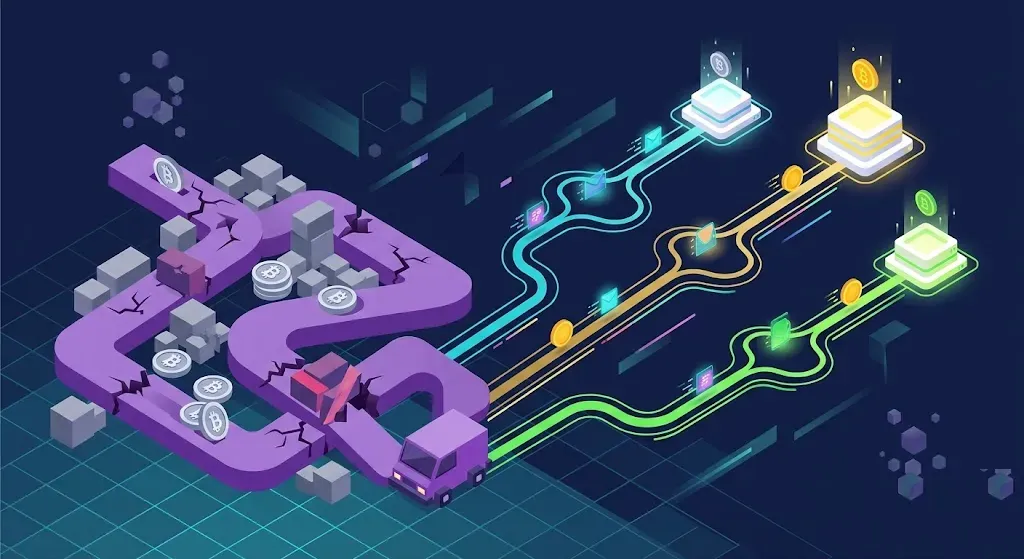
If ERC20 isn't required for your use case, here are the cheaper alternatives:
- Alternative 1: TRC20 (most universal) — $2–4 per transfer, supported on every major exchange. Details in TRON (TRC20) USDT Transfer Guide.
- Alternative 2: BEP20 (cheapest) — $0.05–$1 per transfer, fast confirmations. Details in BEP20 USDT Transfer Guide.
- Alternative 3: Ethereum Layer 2 (Arbitrum / Optimism / Base) — $0.01–$0.10 per transfer, inheriting Ethereum mainnet security. Note that L2 is a separate network option on exchanges and can't be mixed with ERC20 mainnet.
- Alternative 4: Solana — <$0.001 per transfer, the fastest. But exchange support isn't as universal as TRC20, and Solana has had outages historically.
8. Frequently Asked Questions
Q: Gas is so low now — is it safe to use ERC20 again?
Idle-hour gas is genuinely low, but there's no guarantee your next operation will land in an idle hour. Major events (FOMC, liquidation cascades, popular NFT drops) can push gas from 1 Gwei to 200 Gwei in minutes. If your strategy can't tolerate delays, you need a chain with stable cost.
Q: Is ERC20 USDT the same as ERC20 USDC?
Both are stablecoins under the ERC20 standard, sharing identical gas mechanics — transfer costs are nearly the same. The difference is the issuer: USDT is from Tether, USDC from Circle. USDC is favored by institutions for compliance and transparency; USDT has higher liquidity and broader pair coverage.
Q: How do I convert ERC20 to TRC20 / BEP20?
Easiest path: deposit USDT-ERC20 into Binance / OKX / Bybit (deposits are free), then withdraw with TRC20 or BEP20 selected. The exchange handles the chain conversion internally — you only pay one ERC20 deposit gas + one target-chain withdrawal fee. Cross-chain bridges work too, but aren't recommended for beginners.
Q: Do Layer 2s (Arbitrum / Base) count as ERC20?
Technically no. L2s are independent chains that share Ethereum mainnet's security but have their own networks. On exchange withdrawal screens, Arbitrum, Optimism, and Base are separate options. If you want Ethereum's ecosystem with low fees, L2 is the rational middle ground.
Q: Will Ethereum gas keep dropping in the future?
Probably yes. The post-Pectra Fusaka upgrade (expected late 2026) will introduce PeerDAS and further blob capacity expansion. But structurally, Ethereum mainnet will never be cheaper than BEP20 / TRC20 — that's the fundamental trade-off between decentralization and low fees. You can't have both.
Use the Right Chain for AI Trading
If your goal is automated AI trading via CoinTech2u, sidestepping ERC20's cost unpredictability and depositing via TRC20 or BEP20 is the more rational starting point.
Related: TRC20 USDT Complete Guide · BEP20 USDT Complete Guide · USDT Network Decision Guide
Once your account is ready, you can connect
With networks, fees and sub-accounts sorted out, the remaining step is putting a strategy to work. CoinTech2u connects to your own exchange account over API — your funds never pass through us.
Create a free account