BEP20 USDT Transfer Guide: The Cheapest USDT Network? Fees of $0.05–$1 (2026)
BEP20 is one of the cheapest networks for USDT transfers — but support isn't as universal as TRC20. This guide covers real fees, the BNB Chain mechanism, exchange support map, and exactly when you should (and shouldn't) use BEP20.
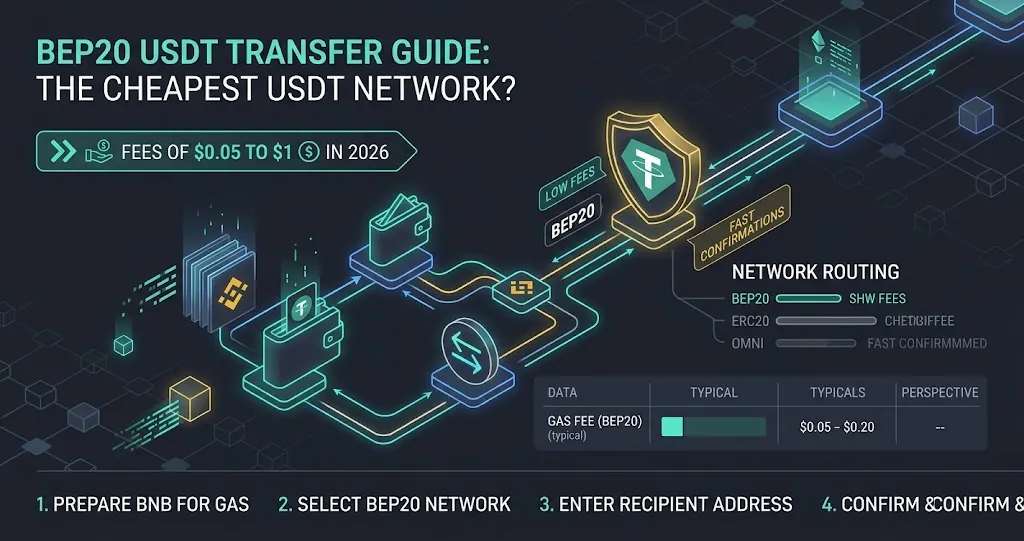
If BEP20 is available, take it — at $0.05–$1 per transfer, it's 5–20× cheaper than TRC20. The trade-off: not every exchange supports it, and you'll need a small BNB balance for gas. This guide uses April 2026 data to tell you when BEP20 is the right call, and when to fall back to TRC20.
In the previous article, we covered the real cost of TRC20 USDT ($2–4 per transfer). This time we're looking at BEP20 on BNB Chain — same USDT, same ~3-second confirmations, but only a few cents per transfer. If you transfer 10–20+ times a month, the difference adds up to hundreds of dollars a year in fees alone.
1. What Are BEP20 and BNB Chain?
BNB Chain (formerly Binance Smart Chain, BSC) is a smart contract chain launched by Binance in 2020. It's EVM-compatible (works with Ethereum tooling) but uses its own consensus mechanism (PoSA — Proof of Staked Authority), with ~3-second block times and roughly 21 active validators.
BEP20 is the token standard on BNB Chain — equivalent to TRC20 on TRON or ERC20 on Ethereum. USDT-BEP20 is the version of USDT issued on BNB Chain. When you withdraw USDT and select "BSC" or "BEP20" as the network, the assets travel through this chain.
Why BEP20 Stands Out
- Extremely low fees — $0.05–$1 per transfer, 1/10–1/40 of TRC20
- Fast confirmations — ~3 seconds on-chain
- EVM compatible — works directly with MetaMask, Trust Wallet, etc.
- Rich DeFi ecosystem — PancakeSwap, Venus, and other established protocols
2. BEP20 USDT Transfer Fees (Latest 2026 Data)
BEP20 fees come in two layers: on-chain gas (paid in BNB to validators) and exchange withdrawal fee (set by each exchange, often higher than the underlying gas).
On-chain Gas Costs
| Network State | BNB Burned | USD (BNB≈$600) |
|---|---|---|
| Idle (normal hours) | ~0.0001 BNB | ~$0.06 |
| Moderate activity | ~0.0003 BNB | ~$0.18 |
| Peak (DeFi heavy) | ~0.001 BNB | ~$0.60 |
| Extreme congestion | ~0.0015 BNB | ~$0.90 |
$0.05–$0.30 is normal. DeFi peaks can push it to ~$1. Almost never exceeds $1.
Exchange BEP20 USDT Withdrawal Fees
| Exchange | BEP20 USDT Withdrawal Fee | Support Status |
|---|---|---|
| Binance | ~0.29 USDT | ✅ Native, lowest |
| Bitget | ~0.2 USDT | ✅ Full support |
| OKX | Dynamic (~0.3–1 USDT) | ✅ Full support |
| Bybit | ~1 USDT | ✅ Full support |
| KuCoin | ~1 USDT | ✅ Full support |
| Coinbase | ~$2–3 | ⚠️ Supported, higher fees |
| Kraken | ~$1.5–2.5 | ⚠️ Supported, higher fees |
| Gemini | Not supported | ❌ ERC20 only |
Bottom line: For moving USDT between Binance / Bitget / OKX / Bybit, BEP20 is the cheapest option available. But if your flow involves Coinbase or Gemini, the BEP20 advantage shrinks or disappears.
3. Why Is BEP20 So Cheap?
The fundamental reason is different consensus design.
| Chain | Consensus | Validators | Block Time | Trade-off |
|---|---|---|---|---|
| BNB Chain | PoSA | ~21 active | ~3 sec | Speed + low fees vs. decentralization |
| TRON | DPoS | 27 SRs | ~3 sec | Similar, but different energy model |
| Ethereum | PoS | ~1,000,000+ | ~12 sec | Maximum decentralization |
Fewer validators → faster consensus → lower operating cost → lower fees. The price you pay is that a small set of validators can influence network behavior — which is why both BNB Chain and TRON receive criticism around centralization.
What this means in practice: For a USDT transfer that takes minutes, the centralization debate doesn't affect you. But if you're an institution holding tens of millions long-term, or running DeFi protocols, prefer ERC20.
4. BEP20 vs TRC20 vs ERC20 — Direct Comparison
| Dimension | BEP20 (BNB Chain) | TRC20 (TRON) | ERC20 (Ethereum) |
|---|---|---|---|
| On-chain fee | $0.05–$1 | $2–4 | $5–30 |
| Confirmation time | ~3 sec | ~3 sec | ~12–15 sec |
| Required gas asset | BNB | TRX (or rented energy) | ETH |
| Exchange support | Most (except Gemini) | All major | All major |
| USDT supply share | ~5% | ~50% | ~40% |
| Wallet compatibility | EVM (MetaMask works) | TRON-specific wallets | EVM native |
| Decentralization | Lower (21 validators) | Lower (27 SRs) | Highest |
5. When to Use BEP20 (and When Not To)
✅ Use BEP20 when…
- Moving USDT between Binance / Bitget / OKX / Bybit (cheapest fees)
- Funding CoinTech2u via Binance or Bitget (these have the lowest BEP20 withdrawal fees)
- You need to interact with BNB Chain DeFi (PancakeSwap, Venus, etc.)
- You transfer 10+ times per month — BEP20 saves hundreds of dollars per year vs. TRC20
- You already use MetaMask / Trust Wallet and don't want to install a TRON-specific wallet
❌ Don't use BEP20 when…
- The destination exchange or wallet doesn't support BEP20 (e.g., Gemini)
- You're storing large amounts long-term ($100k+) — prefer ERC20 for higher decentralization
- You need maximum compliance acceptance (institutional, tax reporting) — ERC20 is the industry default
- Your wallet has no BNB and you don't know how to obtain it (TRC20 is simpler for first-timers)
- The recipient explicitly says they only accept TRC20 / ERC20
6. Depositing and Withdrawing BEP20 USDT
The general flow: ① Open the exchange's deposit/withdrawal page ② Select USDT ③ Choose network → BSC / BEP20 / BNB Smart Chain (different exchanges name it differently, but it's the same chain) ④ Paste the address ⑤ Confirm. The address starts with 0x — exactly the same format as ERC20 (because BNB Chain is EVM-compatible).
Step-by-step exchange tutorials on the site:
- Binance: Create API and Bind to CoinTech2u
- OKX: Deposit USDT and Convert Gas Fee
- Bitget: Deposit USDT and Convert Gas Fee
- Bybit: Deposit USDT and Convert Gas Fee
7. The 5 Most Common Beginner Mistakes
Pitfall 1: BEP20 and ERC20 share the exact same address format — but the chain is different
This is the most dangerous trap. Both BEP20 and ERC20 addresses are 42-character hex strings starting with 0x — identical format. If the sender picks BEP20 but the receiver only supports ERC20 (e.g., Gemini), funds end up stuck on BNB Chain and won't appear at the destination. Always verify the network selection on both ends.
Pitfall 2: No BNB in the wallet for gas
BEP20 transfers require BNB to pay gas — without BNB, you can't move anything. Send 0.005–0.01 BNB ($3–6) to a new wallet first as a buffer.
Pitfall 3: Sending BEP20 USDT to a non-EVM wallet
If the receiving wallet doesn't support EVM (e.g., a Bitcoin-only wallet), the USDT won't show up at that address — but it's still on BNB Chain. Recovery requires importing the same private key / mnemonic into an EVM-compatible wallet.
Pitfall 4: "BSC" and "BEP20" are the same chain
Different exchanges label this network as "BSC", "BEP20", "BNB Smart Chain", or "Binance Smart Chain" — they're all the same thing. But occasionally you'll see "BEP2" (a separate, mostly-deprecated chain that predates BNB Chain) — never confuse BEP2 with BEP20. They are different chains.
Pitfall 5: Clipboard hijacking
Malware can monitor the clipboard and silently swap your 0x address for an attacker's (with deliberately matching first/last characters). After every paste, verify the entire address — not just the first and last few characters. This applies to all EVM chains.
8. Frequently Asked Questions
Q: Is BEP20 USDT the same as ERC20 USDT?
No — they are different token contracts on different chains, both issued by Tether and pegged 1:1 to USD. Think of them as "same brand, different packaging." Same value, but they live on separate chains and can't be transferred between chains directly — you need an exchange or a bridge.
Q: How do I convert BEP20 to TRC20 / ERC20?
The simplest path: deposit USDT-BEP20 into a centralized exchange like Binance or OKX, then withdraw with TRC20 or ERC20 selected. The exchange handles the chain conversion internally. Cross-chain bridges (cBridge, Wormhole, etc.) work too, but are not recommended for beginners.
Q: How long does a BEP20 USDT transfer take?
~3-second on-chain confirmation. Exchanges typically require 15 block confirmations (~45 seconds) plus risk review, so end-to-end is usually 1–5 minutes. Slightly faster than TRC20.
Q: Can BEP20 USDT be frozen by Tether?
Yes. Tether's USDT contract on BNB Chain retains the same freeze permissions as on ERC20 / TRC20. Day-to-day use of USDT withdrawn from major exchanges carries extremely low risk; freezes typically affect addresses tied to illicit activity or sanctions lists.
Q: Which chain does CoinTech2u recommend for funding?
CoinTech2u doesn't directly receive USDT — funds stay in your own exchange sub-account, and CoinTech2u trades via API. So "which chain to use" is really "what's the cheapest way to get USDT into my exchange." If your exchange is Binance / Bitget / Bybit / OKX, BEP20 is cheapest (chain ~$0.10 + withdrawal $0.2–1). If you're moving from cold storage or another platform, TRC20's universality may be more convenient.
Start AI Trading with the Lowest Fees
Now you know the real cost and trade-offs of BEP20, TRC20, and ERC20. The next step is to register on a BEP20-supporting exchange, fund it efficiently, and connect CoinTech2u to start automated trading.
Related: TRON (TRC20) USDT Transfer Guide · USDT Network Decision Guide
Once your account is ready, you can connect
With networks, fees and sub-accounts sorted out, the remaining step is putting a strategy to work. CoinTech2u connects to your own exchange account over API — your funds never pass through us.
Create a free account